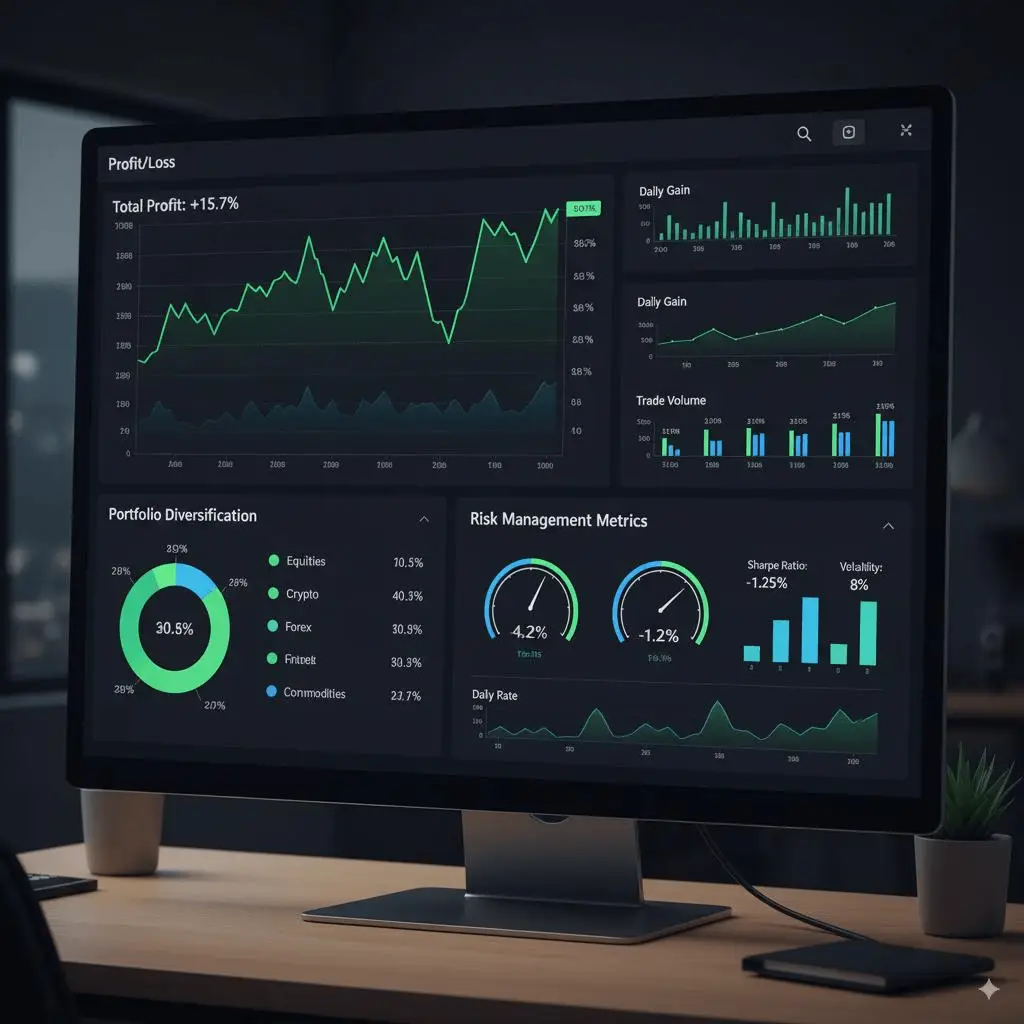
Summary: Transitioning from a demo account to live trading is one of the most critical steps a trader can take. This guide outlines three concrete benchmarks—consistent profitability, risk management discipline, and platform proficiency—that signal readiness. By meeting these evidence-based criteria, traders can approach the live market with confidence, avoiding common emotional and financial pitfalls that derail beginners.
Introduction: The Demo Account Trap
The journey from paper trading to handling real capital is a rite of passage for every aspiring trader. Yet, it is a transition fraught with peril. Many traders make the leap too early, fueled by a few winning trades on a demo platform, only to find their live account decimated within weeks. Others remain in the simulation environment for years, paralyzed by the fear of real financial loss.
The gap between simulated and actual trading is not merely about the presence of real money; it is psychological. When your own capital is on the line, decision-making changes. Emotions like fear and greed become amplified, leading to deviations from your trading plan. A study of retail traders consistently shows that those who survive and thrive in the markets are those who have developed a robust framework for decision-making before they ever put real money at risk .
This article will explore three essential benchmarks that signal you are prepared for the transition. These are not arbitrary goals but evidence-based checkpoints that assess your technical skills and your psychological resilience. By meeting these standards, you can step into the live markets with the confidence that you are not gambling but executing a disciplined strategy.
Benchmark 1: Consistent Profitability Over a Statistically Significant Period
Defining “Consistent”
The first and most obvious benchmark is profitability. However, “consistent” is the operative word here. It is not enough to have a single good month. You need to demonstrate that your strategy is repeatable and effective across various market conditions.
The 100-Trade Rule: Experts often recommend executing at least 100 trades in a demo environment before considering a live account . This sample size helps smooth out luck and provides a more accurate picture of your strategy’s true performance. A strategy that works on 10 trades might be a fluke; a strategy that works on 100 trades has statistical weight.
Performance Metrics to Track:
- Win Rate: The percentage of trades that are profitable.
- Risk-to-Reward Ratio: The average profit of your winning trades compared to the average loss of your losing trades. A ratio of 1:2 or higher is generally considered healthy.
- Maximum Drawdown: The peak-to-trough decline in your account balance during the testing period. This measures the risk you are taking.
| Metric | Description | Why It Matters |
|---|---|---|
| Win Rate | Percentage of profitable trades | Indicates strategy accuracy |
| Risk/Reward Ratio | Average win size vs. average loss size | Ensures wins outweigh losses |
| Max Drawdown | Largest account decline during testing | Measures risk tolerance and strategy resilience |
Testing Across Market Conditions
A strategy that works in a bull market may fail spectacularly in a bear market. A key benchmark is to test your strategy over a period that includes different market environments. This might mean testing through a period of high volatility, low volatility, and trending or range-bound markets. If your strategy only works in perfect conditions, it is not ready for live markets, where conditions are rarely perfect.
Benchmark 2: Unwavering Adherence to Risk Management Protocols
Emotional Discipline Under Pressure
This is perhaps the most critical benchmark. It is often said that trading is 90% psychology and 10% strategy. If you cannot control your emotions, your strategy is worthless.
Key Questions to Ask Yourself:
- Can you take a losing trade without deviating from your plan?
- Can you take a series of losses without revenge trading to “make it all back”?
- Do you cut your losses quickly and let your winners run?
A trader demonstrates emotional discipline when they follow their entry and exit rules, even when it feels uncomfortable. If you are consistently moving your stop-loss (a practice known as “chasing the market”) or closing winners early out of fear of giving back profits, you are not ready .
Calculating Position Sizes Correctly
Risk management is not just about stop-losses; it is about position sizing. Your risk per trade is determined by the size of your position and the distance to your stop-loss.
The 1% Rule: A golden rule in trading is to risk no more than 1% of your account balance on a single trade. For example, if you have a $10,000 account, your maximum loss per trade should be $100. If your stop-loss is 10 pips away, your position size must be small enough to limit the loss to $100. If you cannot calculate this correctly and consistently, you are not ready to trade with real capital .
Benchmark 3: Seamless Platform Proficiency and Transactional Confidence
The Cost of Slippage and Order Execution
In a demo account, you might not experience slippage—the difference between the expected price of a trade and the price at which the trade is actually executed. In live markets, especially during periods of high volatility, slippage is a reality. You need to understand how your trading platform handles market, limit, and stop orders, and how to manage partial fills.
If you are fumbling with order entry, searching for the stop-loss button, or unsure how to calculate your P&L in real-time, you will lose money. This is a critical benchmark to achieve before going live.
Prerequisites:
- No hesitation: You can execute your entry, stop-loss, and take-profit orders in seconds without thinking.
- Error-free execution: You have not made a single order-entry error in your last 50 demo trades.
- Slippage simulation: You have mentally prepared for the fact that your entry price may be a few ticks above or below your intended price.

Also Read: How to Read Market Noise vs. Real Signals: A Trader’s First Filter
The “Platform Review”
Most experienced participants recommend documenting your trading routine. Part of that routine should involve reviewing your platform’s functionality and ensuring you can perform necessary tasks without referencing a manual. This includes setting alerts, drawing trendlines, and understanding the platform’s risk management features .
Conclusion: The Five-Second Decision
The transition from paper to live trading is a profound step. It is a moment where planning meets reality, where psychological fortitude is tested against the cold mechanics of the market. The benchmarks outlined here serve as your compass, ensuring you do not venture into live trading unprepared.
As one trader aptly put it, “The demo account is a place to learn how to take losses without hurting your account. The live account is a place to learn how to take losses without hurting your psyche.”
When you sit down to make that first live trade, you should not be thinking about the potential profit. You should be thinking about your benchmark checklist. You should be confident in your strategy, your risk management, and your ability to execute. If your answer to any of these areas is uncertain, additional time in the demo environment is not a failure; it is a critical part of your journey toward long-term success .
Your Transition Checklist
Before you fund your account, ask yourself these final questions:
- Have I executed at least 100 trades following a defined set of rules?
- Can I demonstrate consistent profitability over a statistically significant period?
- Have I tested my strategy across different market conditions?
- Do I understand how to calculate position sizes based on account equity?
- Can I take a loss without deviating from my plan?
- Have I learned how to manage slippage and partial fills in fast markets?
If you can answer “yes” to these questions, you are demonstrating true preparedness. If any answers are uncertain, continue to build your skills in the paper trading environment.

Also Read: Why Risk Management Belongs Before Your First Trade, Not After
Frequently Asked Questions (FAQ)
1. How many trades should I take in a demo account before going live?
It is generally recommended to complete at least 100 trades following a specific strategy to ensure your results are statistically significant and not just luck .
2. How do I know if my risk management is adequate?
A key indicator is that you are risking no more than 1% of your account per trade and that you can take a loss without emotional distress. Your maximum drawdown should also be within your comfort zone .
3. What is slippage, and how does it affect my live trading?
Slippage is the difference between your expected trade price and the actual execution price. It is more common in fast-moving markets and is a cost that is not typically simulated in demo accounts.
4. Is it okay to start live trading with a small account?
Yes, starting small is highly recommended. It allows you to practice with real money while limiting your financial risk. Many traders find trading a micro-lot or mini-lot account is a good transition.
5. What should I do if I panic during a live trade?
If you panic, you are not ready to manage that level of risk. The best practice is to close the trade and scale down your position size. Trading should not feel like gambling.
6. How do I evaluate my performance in the demo account?
You should track your win rate, risk-to-reward ratio, and maximum drawdown. These metrics provide a comprehensive picture of your strategy’s health and your discipline.
7. When should I review my trading logs?
Most experienced traders recommend reviewing your trading logs weekly and monthly. This helps you identify patterns, reinforce good habits, and correct mistakes.
8. Can I use the same strategy in a live account that I used in demo?
Yes, but you should be prepared for slight variations in execution due to slippage and commission costs. Your live strategy must account for these real-world frictions.
A Note on Educational Resources
For traders seeking to further develop their skills, the following video resources offer valuable insights from reputable industry experts and educational channels. These resources provide complementary perspectives on the benchmarks discussed in this article.
Disclaimer
This content is provided for educational and informational purposes only and does not constitute financial, investment, or trading advice. Trading stocks, options, futures, forex, cryptocurrencies, and other financial instruments involves substantial risk of loss and is not suitable for all investors. Past performance is not indicative of future results.
The benchmarks, strategies, and examples discussed in this article are based on general market principles and hypothetical scenarios; they do not guarantee profitability or protect against losses. You should not trade with capital you cannot afford to lose. Always conduct your own independent research and consult with a qualified financial advisor before making any investment decisions.
Neither the author, the publisher, nor any affiliated entities assume any liability for your trading and investment results. You alone are responsible for your financial decisions and the consequences thereof.